
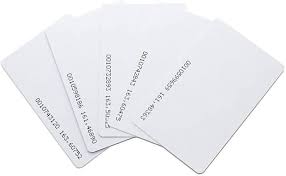
📌 Common RFID Card Frequencies
| Frequency | Name | Typical Uses |
|---|---|---|
| 125 kHz (LF) | Low-frequency RFID | Access control, attendance, basic ID systems |
| 13.56 MHz (HF) | High-frequency RFID (e.g., MIFARE/NFC) | Access control, transport cards, payment & NFC systems |
| UHF (860–960 MHz) | Long-range RFID | Inventory & logistics tracking |
Most blank RFID cards sold are either 125 kHz LF or 13.56 MHz HF. There isn’t a standard RFID technology at 12 kHz — so the product you’re seeing likely meant 125 kHz not 12 kHz.
📇 What “Blank White RFID Cards” Are
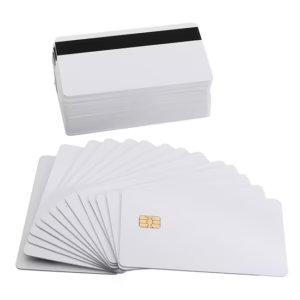
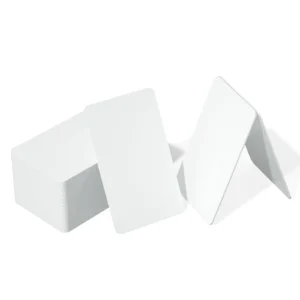
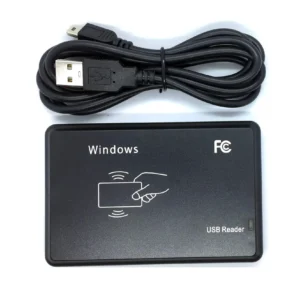
Blank RFID cards are contactless plastic cards with an embedded RF chip and coil antenna, designed to be written/read by compatible RFID systems. “Blank” / “white” simply means:
✅ No printed text or graphics — plain surface you can custom-print.
✅ No pre-encoded data (you can program your own ID).
✅ Commonly used for access badges, attendance cards, parking, membership IDs, etc.
You’ll find them in these frequency categories:
🔹 125 kHz (LF) Blank Cards
-
Standard low-frequency RFID cards.
-
Typically read at short range (few cm).
-
Used in basic access control systems and older RFID readers.
-
Often based on chips like T5577/LF series.
🔹 13.56 MHz (HF) Blank Cards
-
High-frequency cards (NFC/MIFARE compatible).
-
More memory & features than LF; used for modern access systems, NFC apps, transit, etc.
-
Standard ISO14443 protocols.

Reviews
There are no reviews yet.